
The path for founders is often rocky. Nevertheless, there are success stories: from university to founding a company to international success. The flagship start-up air up is one such success story, where everything from the idea to the financing fits together perfectly. We met with air up founder Lena Jüngst and Yvonne Steinbrecher, her advisor at Stadtsparkasse München.
Lena, Confucius is said to have said, ‘The path is made by walking.’ You have been very successful in following this path so far. Did you encounter any of the hurdles that many start-ups report?
LJ: Of course, definitely! We had the same problems: from many unsuccessful discussions about placing our product to financing. We are no exception in that regard.
What do you remember as the biggest hurdle?
LJ: The first and perhaps most decisive hurdle was the decision to start a business in the first place. That wasn't our plan originally. Tim (Jäger, co-founder, editor's note) and I come from a product design background and came up with the idea for air up during our studies. But we had no ambition to start a business. That's rather unusual for product designers. We asked around in our network because we wanted to offer our idea. An old friend then said, ‘You have to do this yourselves.’ But we had no idea how. He ‘put us in touch’ with TUM so that we could present our idea there.
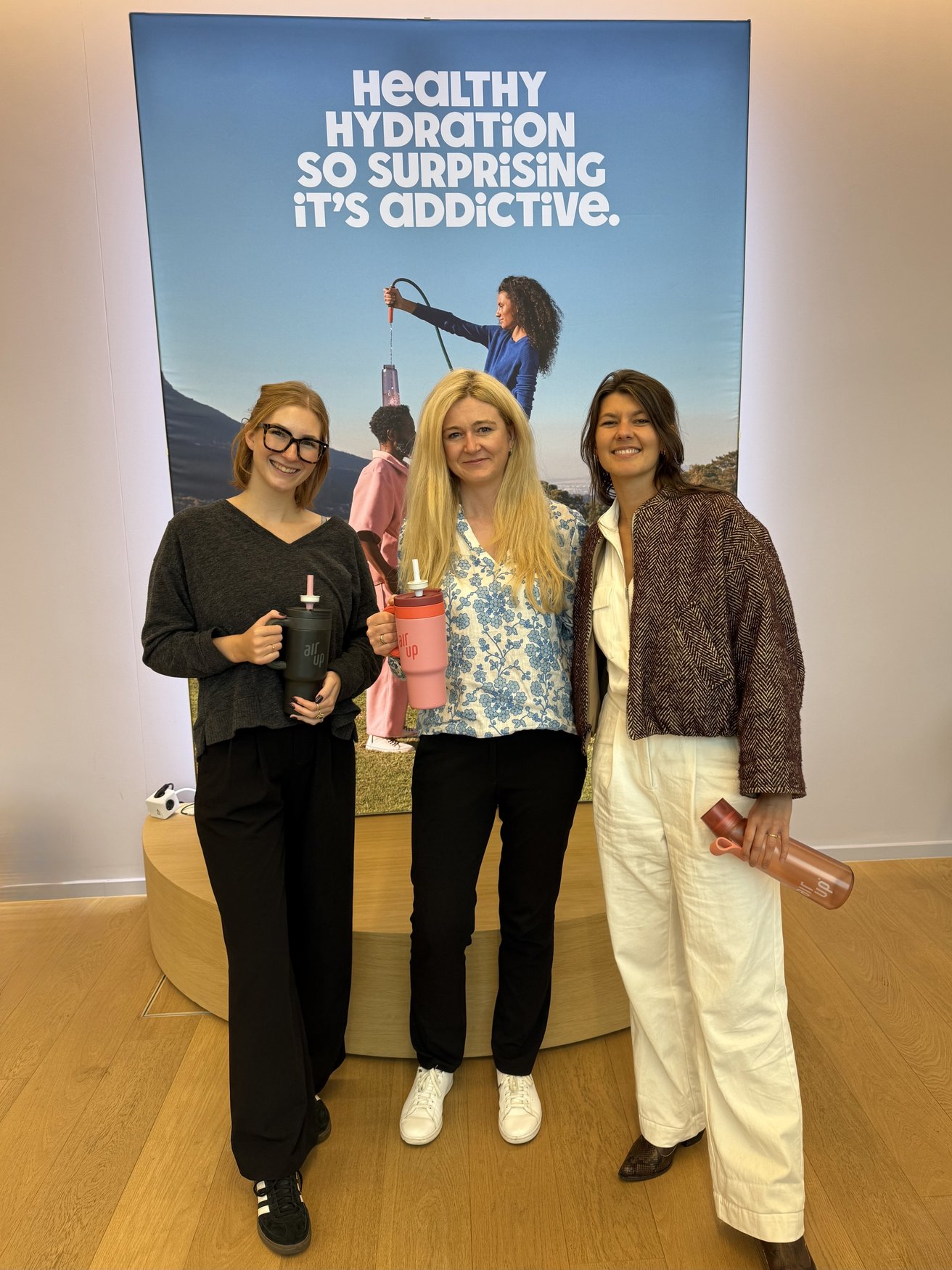
YS: In retrospect, that may have been a decisive factor: you had very good advice right from the start.
LJ: That's right. This enabled us to avoid many mistakes that others have to learn the hard way. And yet it was by no means a sure-fire success. For example, there was already a pronounced health trend at the time, and we thought we had the product that perfectly matched this trend – and then it would take off.
But that wasn't the case?
LJ: No. In the end it did, but I still remember exactly the many unsuccessful meetings we had to present our prototypes.
Did you ever think about giving up?
LJ: Yes, more than once. In hindsight, you only ever see what worked out. The phase we're talking about was extremely difficult. Even though the product wasn't on the market yet, we already had a few partners on board who believed in our idea. And in us. They gave us the benefit of the doubt – we didn't want to disappoint them under any circumstances.
YS: And you never did.
LJ: No, we didn't. But even these partners who were well disposed towards us had to be convinced again and again. And that's really crucial: the partners who are on board have to believe in the idea. This is all the more true when, as in our case, the whole idea is based on an innovation – something that didn't exist before.
In general, we have benefited at pretty much every stage of our development so far from the fact that our immediate network offered a wide range of different perspectives and talents. Not only did they provide mental and emotional support, they also saw solutions that we would not otherwise have seen. We probably made just as many mistakes as others, but our network always gave us a pretty quick idea of how to deal with them and do better. Thanks to our partners.
Speaking of partners: this includes financing, of course, which we'll talk about in a moment, but it also includes having the right partners on the team. In other words, the people you set out to start a business with. How has your role as a founding team changed over the years?
LJ: It has changed a lot and continues to change. We have to keep reminding ourselves of this: we founded the company in 2018, when we had all just left university. By 2019, we already had 30 employees, a year later 70, then 120 – and so on. You first have to find your role and grow into it. Just in terms of managing teams and employees. Or production abroad, etc. These are all things you definitely don't think about when you decide to start a business with an idea you think is great shortly after graduating from university.
Ms Steinbrecher, you see a lot of start-ups and young companies. Not all of them achieve such growth. What did the air up team do differently and, above all, right?
YS: It's really not an everyday occurrence, and in fact there are very few start-ups that take off so quickly. The most obvious thing first: it was simply a great idea and an innovative product. Some business ideas and models are based on making existing products better, cheaper or more efficient. Here we had a truly new product that didn't exist on the market. So it had a certain ‘wow’ effect.
And then there's the fact that Lena and her colleagues took a very deliberate and systematic approach and left practically nothing to chance.
How did that manifest itself, for example?
YS: They were incredibly professional right from the start. For example, they sought out a very experienced commercial director very early on. I am firmly convinced that this saved them a lot of problems. They were pretty much the first to have professional reporting at a very early stage of the company's development – and to work with it. There are companies that have been on the market much longer and still struggle with this.
Let's move on to the topic of financing...
YS: I mentioned the great product and the very professional setup earlier. Both contributed to air up being able to convince others relatively quickly. That was also the case in the first round of investors. You raised a lot of money there.
LJ: In retrospect, we hit the absolute jackpot there...
YS: You could say that. That laid a solid foundation and you had sufficient liquid funds. And – this is also part of it – you were profitable in a very short time. This is where what I mentioned earlier comes into play: professional reporting with key figures that you can then work with. That was quite extraordinary.
Lena, was this first round of investment the turning point for you?
LJ: I would say so. The first round of financing is probably the most difficult for start-ups. And it went very well for us.
Ms Steinbrecher, you mentioned profitability. That hasn't always been the strong point of start-ups. Do you see a change there?
YS: I actually have the impression that profitability is being emphasised at an earlier stage today than it was a few years ago – not only intrinsically motivated by the start-ups, but above all by the investors. While interest rates were hovering around zero four or five years ago, investors now have more options for earning money on the capital market again. In our view, this has an impact on investor expectations and thus on the entire start-up culture. It has changed.
Speaking of change, Lena, what changes do you see in start-ups?
LJ: I can't say that across the board, because the industries are too different. In our environment, however, we are seeing and hearing, for example, that brick-and-mortar retail has become more important again. The days of pure online retail seem to be over, and it is crucial to be visible on retail shelves. Consumer behaviour is returning somewhat to what it was before Covid.
How are you responding to this?
LJ: We have already responded and concluded agreements with many retail companies. Not only in Germany, but also in our other markets.
Speaking of other markets, to what extent is internationalisation an issue for you?
LJ: We are now active in 14 markets, so it is a very big issue for us, one that constantly gives rise to new topics and priorities – such as the aforementioned shift to retail. Internationalisation has also changed the investor base, with very large investors such as Pepsi coming on board. At this point, it no longer feels like a start-up, but very much like a ‘mature’ company. The decision to move production from China to Europe was another decision we made in the context of an international strategy.
Earlier, we heard about everything air up has done right from a banking perspective. Let's ask the opposite question: what makes the collaboration with Ms Steinbrecher and Stadtsparkasse München valuable for air up?
LJ: I'm happy to return the compliment about our professional approach: we consider Stadtsparkasse to be very professional. Then there's the human factor. In Yvonne, we have a contact person who is interested in us, committed to us and understands us. And we also feel the advantage of a regional bank where decisions are made locally.
In a nutshell: I enjoy working with air up because...
YS: ... the contact persons are incredibly nice and friendly, and because everything just runs like clockwork.
Again, in a nutshell: I enjoy working with Stadtsparkasse München because...
LJ: ... it gives us a good feeling to have a reliable partner at our side, and because it's a very pleasant human contact. Yvonne always has an open ear for us and we can just cycle over. I think that's great.
Last question: What did you underestimate and what advice would you give to a start-up?
I think I really underestimated how exhausting it would be. And it never stops. I'm a little reluctant to give advice because other industries have different requirements. So I can only say what I've learned for myself and for us: you have to be prepared to fail. Only then will you dare to keep trying. And you have to stay on the ball all the time. Success today is no guarantee of success tomorrow.