
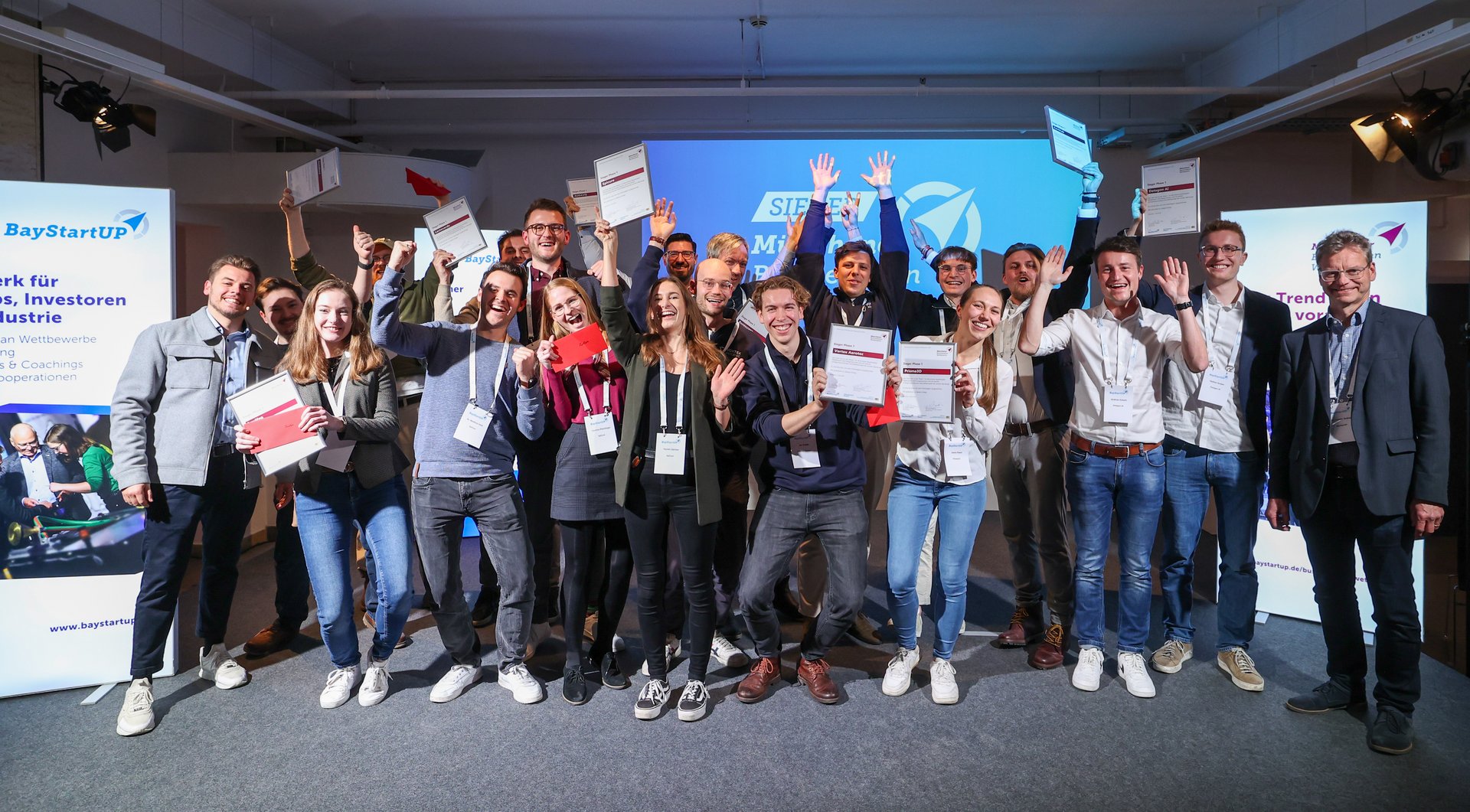
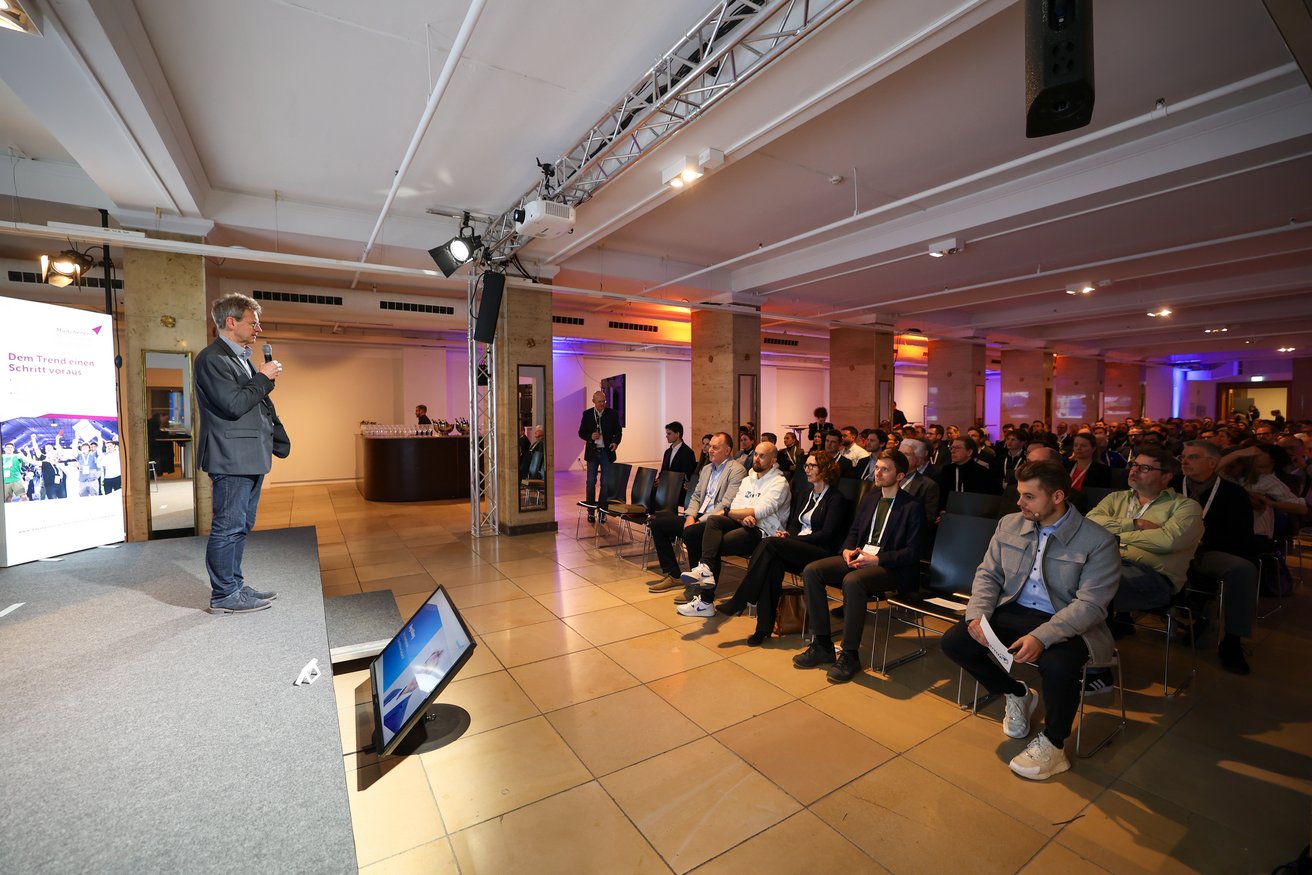
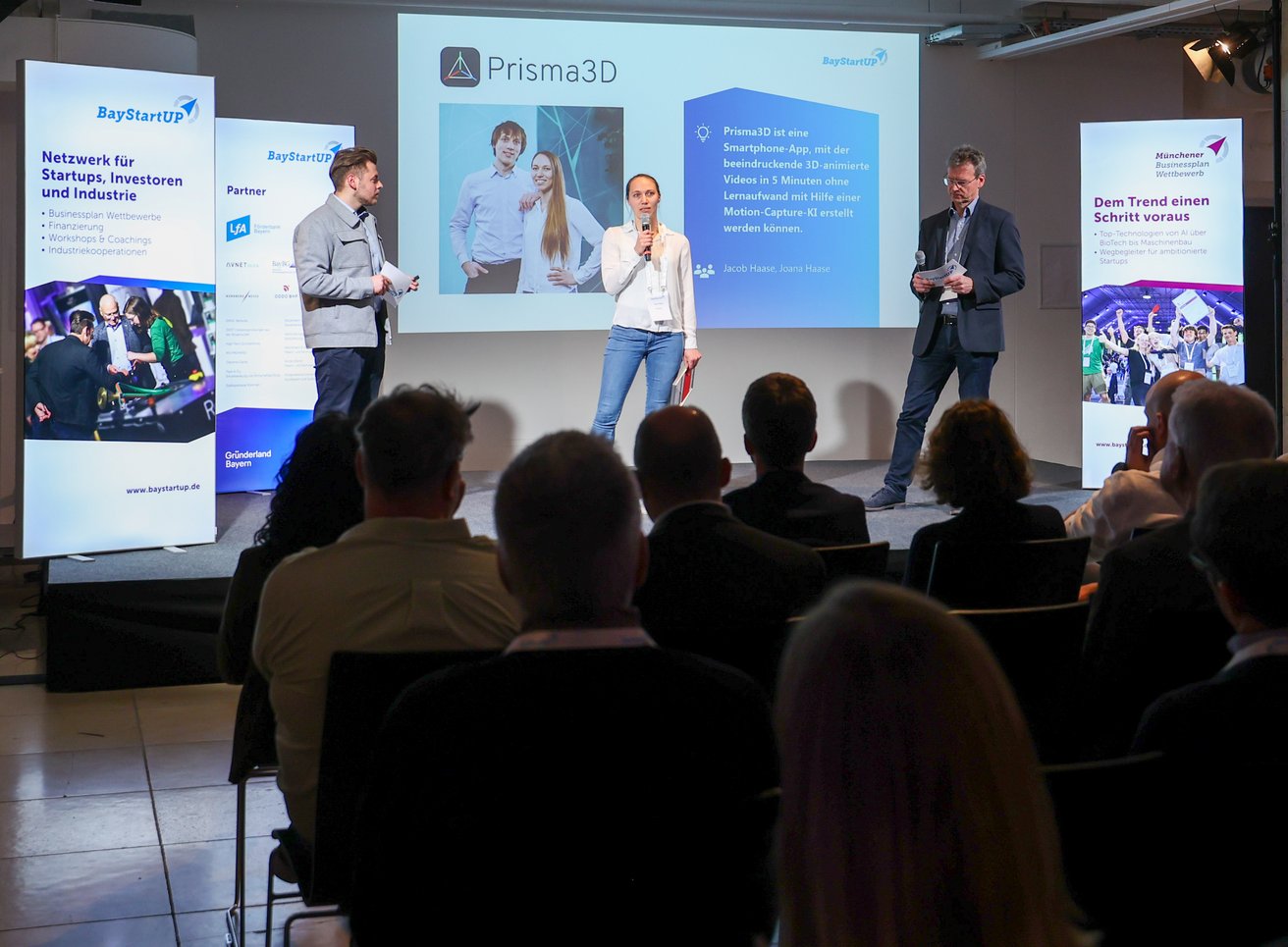
The nominees for the first phase of the Munich Business Plan Competition 2025 have been finalised. Here we present the contenders for the winner's podium. We will select the winners on 20 March at ZIRKA - Zentrum für interdisziplinäre Raum- und Kulturarbeit. Register now and experience the ideas of the nominees and their founders live and in colour.
- AudienceAI offers a platform for synthetic customer profiles that enables companies to quickly and precisely analyse target groups and go-to-market strategies with the help of AI-generated profiles.
- Beautechful from the Technical University of Munich helps customers find the perfect make-up product to suit their skin tone, skin type and individual preferences with an AI-powered self-service terminal for cosmetics shops.
- BioExoTec from the Technical University of Munich is developing a liquid biomarker test based on blood or saliva for the non-invasive early detection of cancer using molecular diagnostics.
- Brakeable from Munich University of Applied Sciences uses artificial intelligence to automate the processing of product service requests such as repairs and warranty claims, thereby reducing costs for customer service teams.
- iNSyT Technologies from Ludwig-Maximilians-Universität München is developing a non-invasive real-time microscope for ultrafast nanoscale processes that will transform research and development in the fields of materials science and green energy.

- Lemonflow.ai offers an AI voice assistant for customer service at charging stations that has been specially developed for the electric charging sector.
- Linque from Ludwig-Maximilians-Universität München uses disruptive photonic integrated circuits for information processing in the optical domain to enable various applications in computer and network infrastructure.
- MarketVista digitises shelves in food retail. By using AI and shelf cameras, the placement of products and advertising campaigns is continuously analysed so that retailers can close gaps more quickly and distribute tasks more efficiently.
- MEDIHUB is digitalising the healthcare sector by automating manual procedures to make patient care more efficient and sustainable.
- MUVOpt from the University of the Federal Armed Forces in Munich develops software for the coordination and planning of autonomous drones, including optimised flight routes and real-time navigation. The software uses mathematical methods and innovative AI processes for robust strategies and fast calculations.
- Neuraforge develops AI models to reliably recognise deepfakes and AI manipulations in images and videos.
- ONYX is developing a SaaS based on new mathematical models for the more efficient and faster development of biopharmaceutical active ingredients.
- OVRLAY uses computer vision and immersive AI technologies to automatically generate high-quality digital 3D models from photos and videos, saving companies time and money.
- Peak Quantum from the Technical University of Munich develops, manufactures and distributes highly reliable quantum computing processors and accelerates the industrial breakthrough of this key technology.
- ProP from Ludwig-Maximilians-Universität München is developing a therapy for type 2 diabetes based on designed pro-proteins that sustainably lowers blood sugar levels and reduces the numerous secondary diseases.
- SmartFoodie uses innovative 24-hour vapour food vending machines that provide fresh, hot meals in 90 seconds.
- SoreAlert is developing an intelligent sensor plaster for patients with restricted mobility that enables effective pressure ulcer prevention.
- Tenum is the software development platform for Agentic Age, with which professional WebApps, SaaS and hybrid apps can be efficiently developed and operated.
- Thermovation from Ingolstadt University of Applied Sciences is launching an affordable heat pump for single-family homes that can be installed alongside an existing oil or gas heating system and costs just €2,999 including installation.
- Versatile Robotics from the German Aerospace Centre (DLR) uses special control software to give robots sensitivity and address challenges such as slow robots, stability problems and low precision.